Improve Quality Assurance with CMM Machines
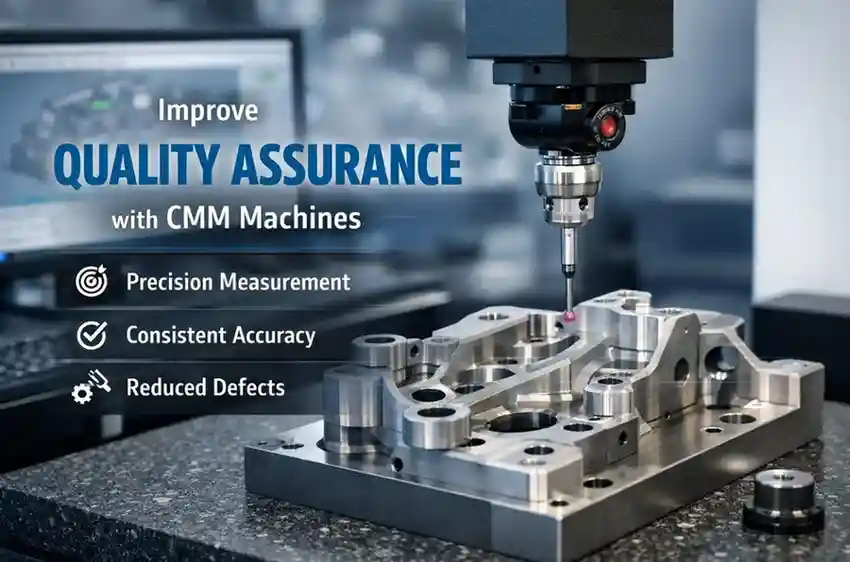
Improve Quality Assurance with CMM Machines
In today’s highly competitive manufacturing environment, maintaining precision and consistency is no longer optional—it’s essential. Businesses across aerospace, automotive, medical, and heavy engineering sectors are increasingly adopting Coordinate Measuring Machines (CMM) to enhance quality assurance and minimize costly defects.
This in-depth guide explores how CMM machines improve quality control, reduce manufacturing errors, increase ROI, and help companies meet global compliance standards.
What is a CMM Machine?
A Coordinate Measuring Machine (CMM) is an advanced industrial inspection system used to measure the physical geometrical characteristics of an object. It uses probes (touch or non-contact sensors) to collect precise data points and compare them with CAD models.
CMM machines are widely used for precision measurement, ensuring that manufactured components meet exact design specifications.
Why Quality Assurance is Critical in Manufacturing
Quality assurance (QA) ensures that products are manufactured within defined standards and tolerances. Poor QA leads to:
- High rejection and rework rates
- Customer complaints and returns
- Production delays
- Increased operational costs
By implementing CMM machines, manufacturers can significantly improve product quality and reduce these risks.
How CMM Machines Improve Quality Assurance
1. High Precision Measurement
CMM machines offer micron-level accuracy, ensuring every component meets exact specifications. This level of precision is essential in industries like aerospace and medical manufacturing.
2. Automated Inspection Process
Modern CMM systems are integrated with automation, reducing human error and ensuring consistent inspection results across batches.
3. Real-Time Data Analysis
CMM machines provide real-time measurement data, enabling manufacturers to identify defects instantly and take corrective action.
4. Reduced Human Error
Manual inspection is prone to inconsistencies. Automated CMM systems eliminate variability and improve reliability.
5. Faster Inspection Cycles
Automated CMM systems reduce inspection time, allowing manufacturers to maintain high production speeds without compromising quality.
Types of CMM Machines
Bridge CMM
Most common type used in manufacturing plants for high-precision inspection.
Gantry CMM
Used for large components such as automotive frames and aerospace parts.
Horizontal Arm CMM
Ideal for measuring large and complex parts with open structures.
Portable CMM
Handheld systems used for on-site inspections and flexibility.
Cost of CMM Machines in 2026
The cost of coordinate measuring machines varies depending on accuracy, automation, and size.
| Type of CMM | Price Range (USD) | Best For |
|---|---|---|
| Portable CMM | $10,000 - $50,000 | On-site inspection |
| Bridge CMM | $50,000 - $200,000 | General manufacturing |
| Gantry CMM | $200,000 - $1,000,000+ | Large components |
| Automated CMM Systems | $150,000 - $500,000+ | High-volume production |
Benefits of Using CMM Machines
1. Defect Reduction
Accurate measurement ensures fewer defects and improved product quality.
2. Improved Production Efficiency
Automated inspection reduces downtime and speeds up manufacturing processes.
3. Cost Savings
Reduced rework and scrap significantly lower production costs.
4. Better Compliance
Ensures compliance with international standards like ISO and industry-specific regulations.
5. Enhanced Customer Satisfaction
High-quality products lead to improved customer trust and brand reputation.
CMM vs Traditional Inspection Methods
| Parameter | CMM Machines | Manual Inspection |
|---|---|---|
| Accuracy | Very High | Moderate |
| Speed | High | Slow |
| Consistency | Excellent | Variable |
| Automation | Fully Automated | Manual |
Industries Using CMM Machines
Aerospace
Ensures precision in aircraft components where safety is critical.
Automotive
Used for engine parts, chassis inspection, and assembly validation.
Medical Devices
Maintains accuracy in surgical tools and implants.
Electronics
Ensures precision in micro-components and circuit boards.
ROI of CMM Machines
Investing in CMM machines delivers measurable ROI through defect reduction and improved productivity.
| Metric | Before CMM | After CMM |
|---|---|---|
| Defect Rate | 10% | 2% |
| Inspection Time | 30 mins | 10 mins |
| Production Output | 100 Units | 140 Units |
Integration with Smart Manufacturing
CMM machines are a key component of Industry 4.0 and smart factories. They integrate with:
- IoT-enabled sensors
- Cloud-based analytics platforms
- AI-driven inspection systems
- Digital twin technology
Future Trends in CMM Technology
- AI-powered inspection systems
- Fully automated quality control lines
- Real-time predictive quality analytics
- Advanced 3D scanning integration
How to Choose the Right CMM Machine
- Evaluate measurement accuracy requirements
- Consider production volume
- Check automation capabilities
- Analyze total cost of ownership
- Ensure compatibility with existing systems
Expert Tips
- Invest in scalable systems for future growth
- Choose reliable and certified suppliers
- Focus on long-term ROI rather than upfront cost
Conclusion
CMM machines have become an essential part of modern manufacturing, enabling companies to achieve superior quality assurance and reduce defects significantly. By investing in advanced precision measurement systems, businesses can improve efficiency, reduce costs, and maintain a competitive edge in global markets.
Whether you are in aerospace, automotive, or medical manufacturing, adopting CMM technology can transform your quality control processes and deliver long-term profitability.
Ready to improve your manufacturing quality? Implementing CMM machines is the smartest step toward precision, efficiency, and success.
Comments (3)