How Metrology Machines Reduce Defects in Manufacturing
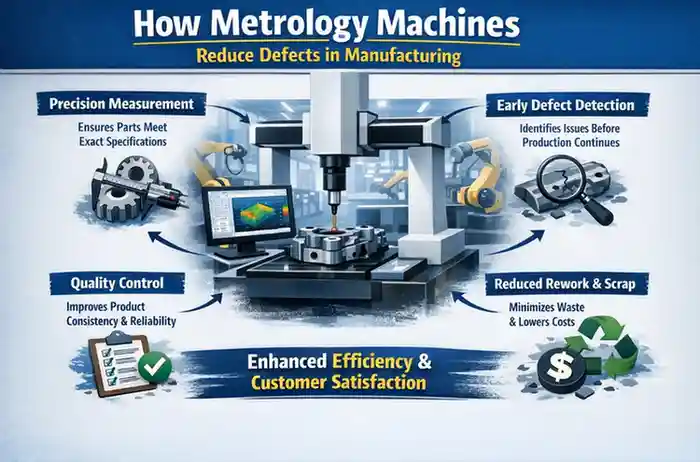
How Metrology Machines Reduce Defects in Manufacturing
In today’s high-precision manufacturing environment, even the smallest deviation can lead to costly defects, production delays, and customer dissatisfaction. To address these challenges, industries worldwide are adopting industrial metrology machines as a core part of their quality control strategy.
This comprehensive guide explains how precision measurement systems help reduce defects, improve product accuracy, and deliver measurable ROI across modern manufacturing operations.
What Are Metrology Machines?
Metrology machines are advanced tools used to measure, inspect, and validate the physical dimensions and geometries of manufactured components. These systems play a critical role in ensuring that products meet design specifications and quality standards.
Why Defect Reduction Matters in Manufacturing
Defects in manufacturing can lead to significant financial and operational consequences:
- Increased production costs
- Material wastage
- Product recalls and warranty claims
- Loss of customer trust
By implementing advanced industrial QA equipment, manufacturers can significantly reduce these risks.
How Metrology Machines Reduce Defects
1. High-Precision Measurement
Modern precision measurement systems offer micron-level accuracy, ensuring that every component meets strict tolerances.
2. Real-Time Quality Inspection
Automated systems provide real-time feedback during production, allowing immediate correction of deviations.
3. Automated Quality Control
Quality control automation reduces human error and ensures consistent inspection processes.
4. Early Defect Detection
Metrology systems identify defects at early stages, preventing costly downstream issues.
5. Data-Driven Manufacturing
Advanced analytics enable manufacturers to identify trends and optimize processes.
| Parameter | Without Metrology | With Metrology |
|---|---|---|
| Defect Rate | 10-15% | 2-4% |
| Inspection Accuracy | Moderate | Very High |
| Rework Cost | High | Low |
Types of Metrology Machines for Defect Reduction
Coordinate Measuring Machines (CMM)
Widely used for precise measurement of complex geometries.
Optical Measurement Systems
Ideal for non-contact inspection of delicate components.
3D Laser Scanners
Enable fast and accurate inspection of complex shapes.
Vision Inspection Systems
Automated systems for high-speed production environments.
Industrial Applications
Automotive Industry
Ensures precision in engine components and assemblies.
Aerospace Industry
Maintains strict tolerances for safety-critical parts.
Electronics Industry
Used for inspecting micro-components and PCBs.
Medical Devices
Ensures accuracy in implants and surgical tools.
Benefits of Using Metrology Machines
- Reduced defect rates
- Improved product quality
- Lower production costs
- Enhanced operational efficiency
- Better compliance with standards
Cost Savings and ROI
Investing in defect reduction tools delivers significant ROI through improved efficiency and reduced waste.
| Metric | Before Implementation | After Implementation |
|---|---|---|
| Defect Rate | 12% | 3% |
| Production Cost | High | Reduced by 25-40% |
| Customer Complaints | Frequent | Minimal |
Integration with Smart Manufacturing
Modern metrology systems integrate seamlessly with smart manufacturing environments:
- IoT-enabled sensors
- Cloud-based analytics
- AI-driven defect detection
- Predictive maintenance systems
Future Trends in Defect Reduction
- AI-powered inspection systems
- Real-time quality monitoring
- Digital twin technology
- Fully automated inspection lines
How to Choose the Right Metrology System
- Define measurement requirements
- Evaluate accuracy and speed
- Consider automation capabilities
- Analyze total cost of ownership
Expert Tips:
- Invest in scalable solutions
- Focus on long-term ROI
- Train operators effectively
Conclusion
Industrial metrology machines are essential tools for reducing defects and improving manufacturing accuracy. By adopting advanced precision measurement systems and industrial QA equipment, businesses can enhance quality, reduce costs, and achieve sustainable growth.
In an increasingly competitive global market, investing in quality control automation is not just an option—it is a necessity for long-term success.
Ready to eliminate defects and improve product quality? Metrology machines are the key to achieving precision-driven manufacturing excellence.
Comments (3)