Submerged Arc Welding Machine Price, Benefits & Applications
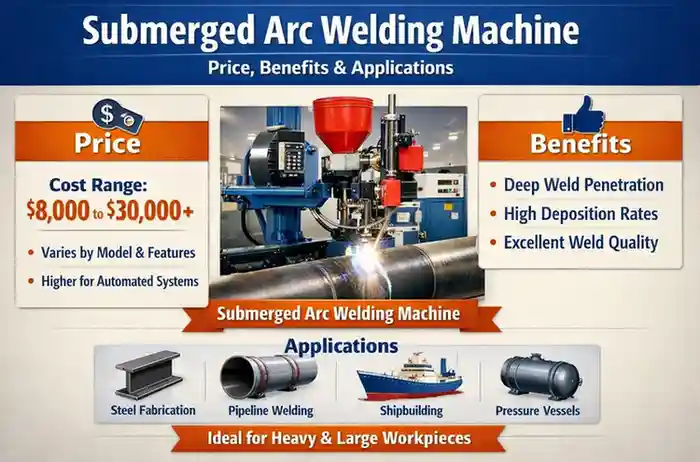
Submerged Arc Welding Machine Price, Benefits & Applications
In the world of heavy fabrication and industrial manufacturing, welding plays a critical role in ensuring structural integrity and durability. Among the various welding technologies available today, Submerged Arc Welding (SAW) stands out as one of the most efficient, high-quality, and cost-effective solutions for large-scale production.
This comprehensive guide explores everything manufacturers need to know about submerged arc welding machine price, benefits, applications, and how modern welding automation systems are transforming industrial fabrication processes.
What is a Submerged Arc Welding (SAW) Machine?
A SAW welding machine is an advanced welding system that uses a continuously fed consumable electrode and a blanket of granular flux to create high-quality welds. The arc is "submerged" under the flux, preventing spatter, sparks, and harmful radiation.
This process is widely used in industries requiring deep penetration welds and consistent quality, such as shipbuilding, pipeline construction, and pressure vessel manufacturing.
How Submerged Arc Welding Works
The SAW process involves:
- Continuous feeding of a welding wire
- Application of granular flux over the weld zone
- Formation of a protective slag layer
- High heat generation for deep penetration
The result is a clean, strong, and uniform weld with minimal post-processing.
Submerged Arc Welding Machine Price in 2026
The submerged arc welding machine price varies based on automation level, capacity, and features.
| Machine Type | Price Range (USD) | Best For |
|---|---|---|
| Manual SAW Machines | $5,000 - $20,000 | Small fabrication units |
| Semi-Automatic SAW Machines | $20,000 - $80,000 | Medium-scale production |
| Automatic SAW Systems | $80,000 - $250,000+ | Heavy industrial applications |
| Fully Automated Welding Lines | $250,000 - $1M+ | Large manufacturing plants |
Key Benefits of SAW Welding Machines
1. High Welding Productivity
SAW machines deliver significantly higher deposition rates compared to traditional welding methods, making them ideal for mass production.
2. Superior Weld Quality
The flux layer protects the weld from contamination, resulting in high-quality, defect-free welds.
3. Deep Penetration
SAW provides deeper weld penetration, reducing the need for multiple passes.
4. Minimal Spatter and Smoke
The submerged arc process eliminates spatter and reduces fumes, improving workplace safety.
5. Cost Efficiency
Lower material waste and higher efficiency lead to reduced overall production costs.
Industrial Applications of SAW Welding Machines
Shipbuilding Industry
Used for welding large steel plates and structural components.
Oil & Gas Sector
Essential for pipeline welding and pressure vessel fabrication.
Construction Industry
Used in bridges, buildings, and heavy structures.
Power Generation
Critical for manufacturing boilers and turbines.
Heavy Engineering
Widely used in manufacturing heavy machinery and equipment.
Welding Automation Systems & Industry 4.0
Modern welding automation systems are revolutionizing fabrication processes. Advanced SAW machines now feature:
- CNC-controlled welding parameters
- Robotic welding arms
- IoT-enabled monitoring systems
- Real-time quality control
These technologies improve consistency, reduce human error, and enhance productivity.
Cost Breakdown of SAW Welding Machines
Understanding the total cost of ownership is essential when investing in industrial welding equipment.
1. Initial Investment
Includes machine purchase, installation, and setup.
2. Operational Costs
- Power consumption
- Consumables (wire and flux)
- Labor
3. Maintenance Costs
Regular servicing ensures long-term performance and reliability.
Comparison: SAW vs Other Welding Techniques
| Parameter | SAW | MIG Welding | TIG Welding |
|---|---|---|---|
| Productivity | Very High | Moderate | Low |
| Weld Quality | High | Medium | Very High |
| Automation | Highly Suitable | Moderate | Limited |
ROI of Submerged Arc Welding Machines
Investing in SAW machines delivers strong ROI through:
- Increased production speed
- Reduced labor costs
- Lower defect rates
- Improved product quality
| Metric | Before SAW | After SAW |
|---|---|---|
| Production Output | 100 Units | 160 Units |
| Defect Rate | 8% | 2% |
| Labor Cost | High | Reduced by 30-40% |
How to Choose the Right SAW Welding Machine
- Assess production requirements
- Determine automation level needed
- Evaluate budget and ROI expectations
- Consider scalability for future growth
Expert Tips:
- Invest in automated systems for large-scale operations
- Choose reliable brands with strong support
- Evaluate total cost of ownership
Future Trends in Welding Technology
- AI-driven welding optimization
- Robotic welding systems
- Smart factories with IoT integration
- Energy-efficient welding solutions
Conclusion
Submerged arc welding machines are a cornerstone of modern industrial fabrication. With their high productivity, superior weld quality, and cost efficiency, they offer a powerful solution for industries looking to scale operations and improve profitability.
By investing in advanced SAW welding machines and automation systems, manufacturers can achieve higher efficiency, better quality, and long-term growth in an increasingly competitive market.
Ready to upgrade your welding operations? Choosing the right submerged arc welding machine can transform your production capabilities and drive long-term success.
Comments (3)