Rubber Compression Moulding Machines: Types & Price Guide
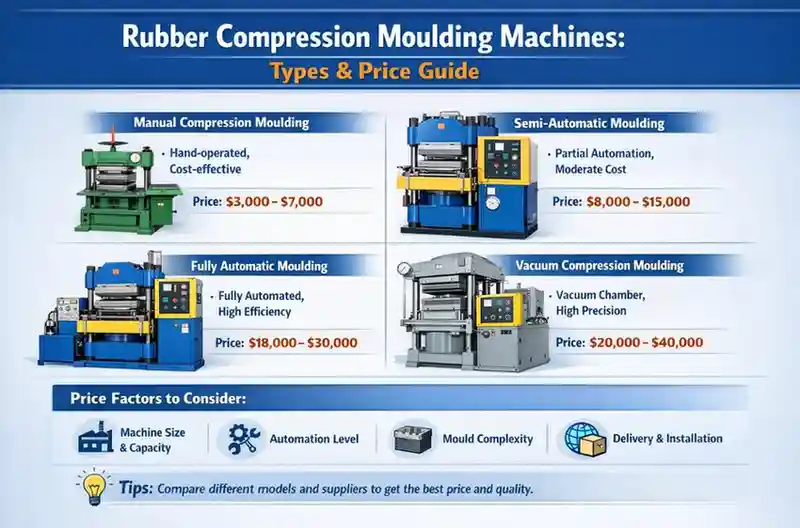
Rubber Compression Moulding Machines: Types & Price Guide
The rubber manufacturing industry is a cornerstone of modern industrial production, supplying components for automotive, aerospace, construction, and consumer goods. One of the most widely used technologies in this sector is the rubber compression moulding machine.
This in-depth guide explores compression moulding equipment, including types, pricing, features, applications, and ROI benefits. Whether you are a manufacturer or investor, understanding these machines is essential for optimizing production efficiency and profitability.
What is a Rubber Compression Moulding Machine?
A rubber compression moulding machine is an industrial press used to shape rubber materials into desired forms by applying heat and pressure within a mould cavity.
This process is widely used for producing high-strength rubber components with precise dimensions and excellent durability.
How Compression Moulding Works
- Pre-measured rubber material is placed into a heated mould.
- The mould is closed using a hydraulic or mechanical press.
- Heat and pressure are applied to shape the material.
- The product is cured and removed from the mould.
Types of Rubber Compression Moulding Machines
1. Hydraulic Compression Moulding Machines
Most commonly used machines offering high pressure and precision.
2. Mechanical Compression Moulding Machines
Operate using mechanical force, suitable for smaller applications.
3. Vacuum Compression Moulding Machines
Used to eliminate air bubbles and improve product quality.
4. Automated Compression Moulding Systems
Fully automated systems integrated with robotics for high-volume production.
Rubber Moulding Machine Price in 2026
The rubber moulding machine price varies based on capacity, automation, and technology.
| Machine Type | Price Range (USD) | Application |
|---|---|---|
| Manual / Small Press | $5,000 - $25,000 | Small-scale production |
| Hydraulic Machines | $25,000 - $150,000 | General industrial use |
| Automated Systems | $150,000 - $500,000+ | High-volume manufacturing |
Key Features of Modern Compression Moulding Equipment
- High-pressure hydraulic systems
- Precise temperature control
- Programmable logic controllers (PLC)
- Energy-efficient operation
- Automated loading and unloading
Industrial Applications
Automotive Industry
Used for manufacturing seals, gaskets, and vibration dampers.
Aerospace Industry
Produces high-performance rubber components for aircraft systems.
Construction Sector
Manufactures insulation materials and structural components.
Consumer Goods
Used in footwear, appliances, and industrial products.
Benefits of Compression Moulding Systems
1. Cost Efficiency
Lower tooling costs compared to injection moulding.
2. High Strength Products
Produces durable and high-quality components.
3. Minimal Material Waste
Efficient use of raw materials reduces waste.
4. Flexibility
Suitable for a wide range of rubber materials.
5. Scalability
Supports both small and large-scale production.
Comparison: Compression vs Injection Moulding
| Parameter | Compression Moulding | Injection Moulding |
|---|---|---|
| Tooling Cost | Low | High |
| Production Speed | Moderate | High |
| Material Waste | Low | Moderate |
ROI of Rubber Moulding Machines
Investing in industrial rubber machines provides strong ROI.
| Metric | Before Automation | After Automation |
|---|---|---|
| Production Output | 100% | 150-200% |
| Defect Rate | 8% | 2% |
| Operational Cost | High | Optimized |
Integration with Smart Manufacturing
Modern moulding systems integrate with advanced technologies:
- IoT-enabled monitoring
- AI-based quality control
- Predictive maintenance systems
- Cloud-based production tracking
Factors Affecting Machine Cost
- Machine size and capacity
- Automation level
- Hydraulic vs mechanical systems
- Energy efficiency features
- Brand and supplier
Future Trends in Rubber Manufacturing
- Fully automated moulding lines
- Eco-friendly materials
- Energy-efficient machines
- AI-driven production optimization
How to Choose the Right Machine
- Evaluate production requirements
- Compare machine specifications
- Analyze total cost of ownership
- Select reliable suppliers
Expert Tips
- Invest in scalable systems
- Focus on energy efficiency
- Prioritize automation for long-term ROI
Conclusion
Rubber compression moulding machines are essential for producing high-quality rubber components across industries. With advancements in compression moulding equipment, manufacturers can achieve higher efficiency, reduced costs, and improved product quality.
By investing in modern industrial rubber machines, businesses can enhance productivity and remain competitive in the global manufacturing landscape.
Ready to upgrade your production line? Choosing the right moulding system can drive long-term growth and operational success.
Comments (3)